|
In Black communities across the country a young "hip-hop generation" is increasingly distinguishing itself from the conventional wisdom of the civil rights establishment. 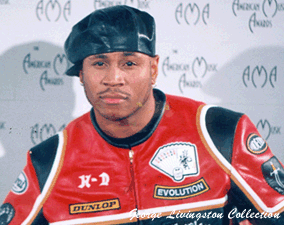 When legendary hip-hop icon LL Cool J recently endorsed New York Republican Governor George Pataki over the Democratic Party nominee, who is Black, it surprised many in New York state politics and the civil rights community. New York State Comptroller H. Carl McCall, the Democratic gubernatorial candidate and the first Black to win a statewide race there, had already secured endorsements of hip-hop icons such as Russell Simmons and Sean "P-Diddy" Combs and was expected to carry favor with hip-hoppers such as LL Cool J. "It's not about parties, it's not about race, it's not about what's cool or not cool," Cool J said in front of a flock of cameras and reporters last month. "It's about action and it's about people stepping up." Though proud McCall was running, Cool J based his endorsement on Pataki's handling of the Sept. 11 terrorist attack in New York. He said he was also impressed with the large amount of economic development that could be seen in his community, which he attributed to Pataki's policies. While hip-hop culture has been one of the defining cultural and social agents of change in the United States in the last 20 years, many older Blacks from the civil rights generation have questioned the culture's political activism and its ability to effect change. When artists or activists from the hip-hop generation do act, many of the old-line civil rights activists expect they will follow their lead. But this doesn't always happen. During the 2001 Los Angeles mayor's race between Kenneth Hahn and Antonio Villaraigosa, Najee Ali, Dominique Diprima and other hip-hop activists broke with the Black civil rights community in supporting Villaraigosa. The Black generation gap can be seen in issues surrounding education, the criminal justice system, entrepreneurship and voter participation. "Our generation is finding our own way," said Hashim Shamori, author of the book "From Da Underground: Hip-Hop Culture as an Agent of Social Change." "While most will vote Democratic, it is not the same type of party allegiance that can be seen in their parents." While Blacks from the civil rights generation lived under Jim Crow laws and other exclusionary practices, Blacks from the hip-hop generation have no memories of this. "The hip-hop generation tend to be more objective in their political thinking," according to Alvin Williams, founder of Black America's Political Action Committee (BAMPAC), which commissioned a study on the differences in the generations. "They do not have the scars that their parents or grandparents had during the Jim Crow era." Williams BAMPAC study found that younger Blacks from the hip-hop generation tend to be more issue-orientated than focused on particular political party. "They will be motivated by issues such as cutting taxes, improving public education and reforming social security. They will vote for candidates based on these issues," Williams said. A third of Blacks aged 26 to 35 consider themselves political independents, according to "Diverging Generations: The Transformation of African American Policy Views," a report by the Joint Center for Political and Economic Studies, a Black think tank. On the issue of school vouchers, traditionally opposed by Democrats, the survey found that Blacks under the age of 50 are much more likely to support vouchers than Blacks over 50. Can the so-called hip-hop generation be organized into a voting bloc? Groups such as Russell Simmons Hip Hop Action Network, which uses artists to publicize an issue, have mobilized a hip-hop generation constituency that successfully protested and reduced education cuts in New York. But critics say this group and others have done little besides hold a series of high-profile rallies and political endorsements. "What does it mean to say you are endorsing someone, but you are not organizing a constituency?" said Bakari Kitwana, author of "Hip-Hop Generation." "On some level it is grandstanding, and on another level, it is a joke." While younger Blacks from the hip-hop generation are beginning to run for political offices or advocate political positions, Kitwana believes it will take grassroots organizing from these artists and activists before the changing dynamic in African American politics is more fully revealed. LL Cool J's endorsement of Pataki may be the first step in that direction. "The world that I come from, a lot of people aren't interested in politics," said Cool J. "But after seeing how the governor handled the 9-11 situation, seeing what happened in this city ... I decided, you know what? I'm going to vote; I'm going to register." PNS contributor Lee Hubbard (superle@hotmail.com) writes on hip-hop, national and urban affairs. |